Restaurant Direct Mail Marketing That Turns Nearby Households Into Customers
Put your restaurant directly into the homes of people most likely to visit with targeted postcards, compelling offers, and measurable direct mail campaigns from DynamiCard.
Restaurants compete for one of the most valuable things in local marketing: the customer’s next meal.
DynamiCard helps restaurants use restaurant direct mail marketing to reach nearby households, introduce compelling offers, promote new locations, bring previous customers back, and create measurable opportunities to drive traffic.
From audience targeting and postcard creative to distinctive plastic mailers, mailing execution, QR engagement, response tracking, and campaign analytics, DynamiCard brings the major pieces of restaurant direct mail together.
Whether you’re marketing one neighborhood restaurant, opening another location, or coordinating campaigns across an entire restaurant group, your strategy should answer four questions:
- Who should receive the offer?
- What will motivate them to visit?
- How will they respond?
- How will you know what happened?
Why Restaurants Use Direct Mail
Restaurant marketing is fundamentally local. Your best potential customers often live within a practical distance of your location. That gives physical direct mail a natural role.
A postcard places your restaurant, food, brand, and offer directly into surrounding households instead of waiting for those customers to search for a restaurant or encounter another online advertisement. Direct mail for restaurants can support:
- New customer acquisition
- Grand openings
- Neighborhood awareness
- Limited-time promotions
- Customer reactivation
- New menu launches
- Loyalty campaigns
- Catering promotion
- Seasonal offers
- Special events
- New-location introductions
- Multi-location restaurant growth
The mailpiece is not simply advertising space. It is an invitation.
Start Restaurant Direct Mail with Geography
A restaurant doesn’t need every household in America. It needs the right households around the locations customers can realistically visit. That makes geography one of the first decisions in a restaurant campaign. DynamiCard can help build campaigns around:
- Neighborhoods near the restaurant
- Priority ZIP codes
- Selected USPS carrier routes
- Defined trade areas
- New expansion markets
- Areas surrounding multiple locations
The objective is not maximum mailing volume. It is relevant local reach. A restaurant with a tight local trade area should not waste its budget on addresses unlikely to become customers.
Target the Right Restaurant Audience
Location is important, but it may not be the only audience consideration. Different restaurant concepts can attract different types of households and occasions. Depending on available data and the specific campaign, audience strategy may consider:
- Geographic proximity
- Household characteristics
- Existing customer data
- Previous customer relationships
- New movers
- Market characteristics
- Other appropriate targeting criteria
DynamiCard’s existing restaurant positioning specifically emphasizes targeting ideal customers rather than relying on broad, untargeted distribution. A fine-dining restaurant and a fast-casual concept should not automatically use the same mailing strategy.
Restaurant Direct Mail for New Customer Acquisition
New-customer campaigns need to accomplish something very quickly: give someone who may not know your restaurant a compelling reason to try it. A strong acquisition postcard should communicate:
- Who you are
- What kind of dining experience you offer
- Where you’re located
- What makes the offer worth considering
- What the recipient should do next
That could mean visiting, scanning, redeeming, calling, or interacting with another campaign-specific response path. The offer should make the first visit easier to justify.
Grand Opening Restaurant Postcards
Opening a restaurant creates an immediate awareness challenge. You need nearby households to know you exist, where you are, what you serve, and why they should visit.
A grand-opening restaurant postcard marketing campaign can focus the entire message around that introduction. Potential postcard elements include:
- Restaurant name
- Opening announcement
- Location
- Cuisine or concept
- Signature menu imagery
- Approved introductory offer
- QR code
- Clear visit or redemption CTA
The creative should avoid becoming an entire menu. The objective is to create curiosity and give recipients one compelling reason to make the first visit.
Offers That Give Customers a Reason to Visit
The offer is often one of the strongest conversion levers in restaurant direct mail. It should be valuable enough to create action without undermining the economics of the campaign. Potential restaurant campaign concepts include:
New Customer Offer
Give nearby households a reason to try the restaurant for the first time.
Gift-Card-Style Promotion
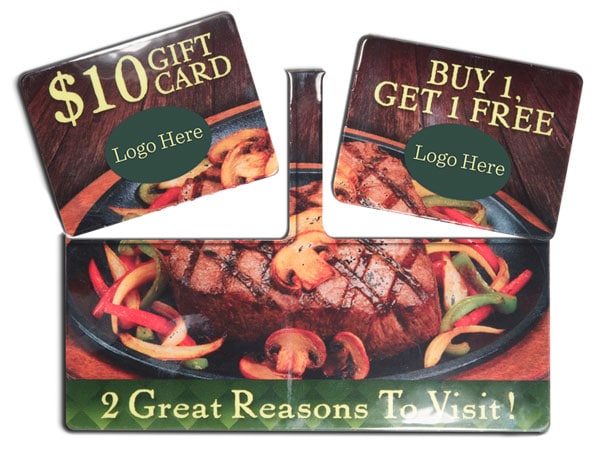
DynamiCard’s current restaurant product strategy prominently features plastic postcards with detachable promotional gift-card-style components.
Entrée or Meal Promotion
Use an approved menu-specific offer to encourage a visit.
Family or Group Offer
Create a campaign around a dining occasion relevant to the restaurant concept.
Loyalty Promotion
Give existing customers a reason to return.
Catering Offer
Promote catering as its own campaign rather than squeezing it into general restaurant advertising.
Birthday or Occasion Marketing
Where appropriate first-party customer data exists, campaigns may support specific relationship or occasion-driven marketing.
Seasonal Promotion
Build around holidays, local events, weather, or seasonal menu opportunities.
Specific dollar amounts, discounts, redemption rules, and promotional terms should come directly from the restaurant.
Gift Cards vs. Traditional Coupons
The existing DynamiCard restaurant product pages emphasize detachable gift-card-style offers as an alternative to conventional paper discount coupons. Strategically, the distinction is about presentation.
Traditional Coupon
Communicates a discount.
Gift-Card-Style Element
May create a different perceived experience — something of value to keep and use.
Whether that approach is right depends on:
- Restaurant positioning
- Offer economics
- Customer experience
- Physical format
- Campaign objective
A premium restaurant may want a different presentation than a value-focused quick-service promotion. The offer format should support the brand.
Restaurant Postcards Should Make the Food and Offer Easy to Understand
Restaurant creative has an advantage: food is inherently visual. But that advantage can be lost if the postcard becomes cluttered.
Lead with Appetite Appeal
Use strong restaurant-specific creative rather than generic advertising imagery.
Make the Restaurant Brand Obvious
Recipients should immediately know which restaurant is sending the piece.
Focus on One Primary Offer
Don’t make ten menu items and four coupons compete for attention.
Show the Location Clearly
Local customers need to know where to find you.
Give the Offer Visual Priority
The promotion should be easy to understand without reading fine print first.
Create a Clear Next Step
Visit. Scan. Redeem. Order. Call. Learn more. The recipient should know what to do without searching the mailpiece for instructions.
Restaurant Postcard Marketing Examples
These are unique campaign concepts rather than claims about completed DynamiCard campaigns.
“Your Next Dinner Is Closer Than You Think”
“We Just Opened in Your Neighborhood”
“We Miss You at the Table”
“Dinner Is Covered Tonight”
“Catering Without the Last-Minute Stress”
“Join Us Again”
Plastic Postcards for Restaurant Marketing
DynamiCard already has a robust restaurant plastic-postcard product ecosystem, including category pages for BBQ, breakfast, burger, fast casual, fast food, fine dining, franchise, French, Greek, Italian, Mexican, pizza, seafood, steakhouse, sushi, and multi-location restaurants.
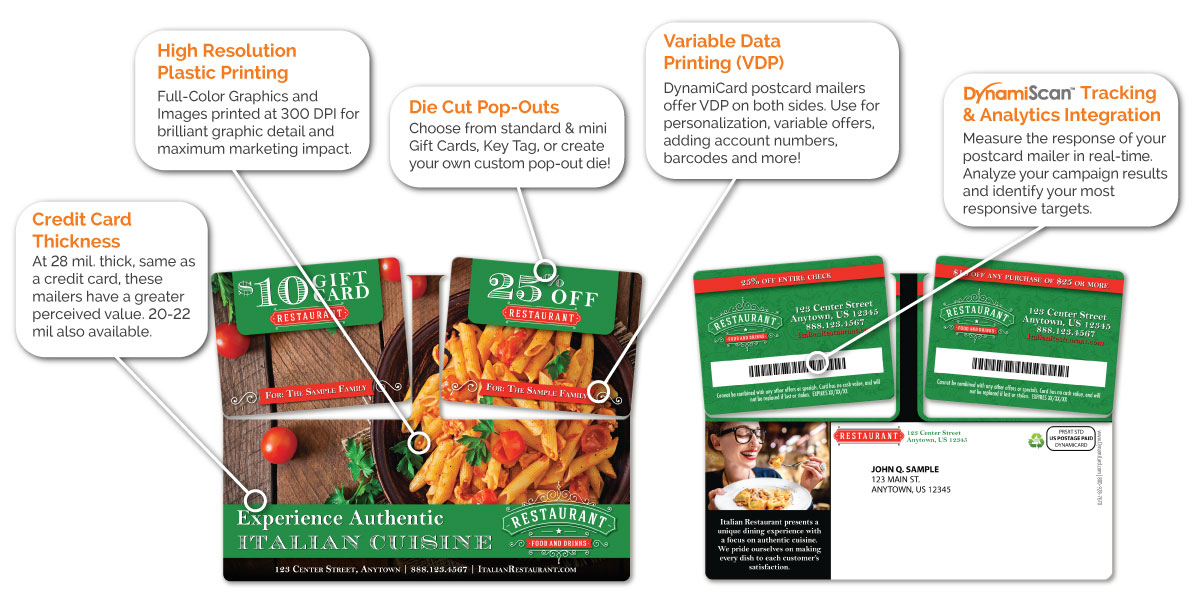
Plastic postcards can provide a distinctive physical experience when that supports the campaign. DynamiCard’s restaurant formats currently include plastic mailpieces with detachable promotional components. They may be worth considering when:
- Physical differentiation matters
- The campaign includes a keepable promotional element
- Brand presentation deserves a more distinctive format
- The offer supports retention
- The restaurant wants the mailpiece to feel different from ordinary paper
Scratch & Sniff Restaurant Mailers
DynamiCard’s current restaurant product offering also promotes scratch-and-sniff capabilities with food-related scent options. This is a genuinely distinctive product feature. For appropriate campaigns, scent can introduce another sensory element to the physical mailpiece. The execution should make strategic sense for:
- Cuisine
- Brand
- Campaign theme
- Offer
- Creative concept
Novelty by itself is not strategy. The sensory element should reinforce the restaurant experience the campaign is trying to communicate.
EDDM for Restaurants
Every Door Direct Mail can be especially relevant for restaurants because customer acquisition is often geographically concentrated. EDDM lets businesses reach addresses across selected USPS carrier routes. This may work well for:
- Grand openings
- Neighborhood awareness
- Broad local promotions
- New locations
- Seasonal campaigns
Could most households in this carrier route realistically become customers?
If yes, broad geographic reach may make sense. If not, a more targeted mailing strategy may be more efficient.
Targeted Restaurant Direct Mail
Some restaurant campaigns benefit from more audience specificity. A targeted strategy may be appropriate when:
- The campaign serves a narrower customer profile
- First-party customer information is available
- Previous customers are being reactivated
- A specific offer only fits part of the market
- Multi-location campaigns require different audiences
- Broad EDDM coverage would create unnecessary waste
The stronger campaign is not necessarily the one that reaches more people. It’s the one that reaches a more useful audience.
Use First-Party Customer Data to Bring Diners Back
Restaurants can also use direct mail for existing relationships. If the business maintains appropriate customer data, audience segmentation can help distinguish between:
- New prospects
- Recent customers
- Loyal customers
- Lapsed customers
- Location-specific customers
- Other meaningful customer groups
Those customers should not necessarily receive the same message. A prospect needs a reason to try the restaurant. A lapsed customer needs a reason to return. A loyal customer may respond to recognition or exclusivity. Audience strategy should reflect the relationship.
Direct Mail for Restaurant Loyalty Campaigns
Repeat business is particularly important in restaurant marketing. DynamiCard’s existing cuisine-specific restaurant pages explicitly position detachable promotional components as useful for membership or frequent-diner campaigns. A loyalty-focused direct mail campaign might be designed around:
- Return visits
- Membership programs
- Frequent-diner programs
- Existing-customer offers
- New menu introductions
- Special events
The economics of a loyalty campaign should be evaluated differently from new customer acquisition. The business already has a relationship with the recipient. The objective is to strengthen it.
Restaurant Direct Mail for Catering
Catering can deserve its own campaign because the buying decision is different from deciding where to eat dinner. A catering postcard may focus on:
- Office lunches
- Family gatherings
- Parties
- Holiday events
- Business events
- Group dining
Instead of using a standard restaurant offer, the CTA might encourage “Request catering information,” “Call about your event,” or “Scan to explore catering options.” When catering has meaningful revenue potential, it should not be hidden as a minor bullet on a generic restaurant postcard.
Seasonal Restaurant Direct Mail
Restaurant behavior changes throughout the year. Campaigns can be built around:
- Holidays
- Seasonal menus
- Outdoor dining
- Back-to-school periods
- Local events
- Catering seasons
- Gift-card periods
- Restaurant anniversaries
- Limited-time menu opportunities
The timing should be planned backward from the customer action. If a campaign promotes a specific holiday, delivery should not be treated as an afterthought.
Track Restaurant Postcard Response with DynamiScan
Measurement is one of DynamiCard’s strongest opportunities to differentiate restaurant direct mail from generic postcard printing. DynamiCard’s existing restaurant page says it uses tracking and analytics to identify the types of people responding to campaigns, and its proprietary tracking environment provides measurable response capabilities.
For restaurant campaigns, analytics can help explore:
- Which offers generate response
- Which audiences respond
- Which neighborhoods produce activity
- Which locations perform differently
- Which promotions should be repeated
- Which customers return
- Which campaign should change
The objective is not simply to report the number of postcards mailed. It is to learn what those postcards generated.
Track QR Engagement from Restaurant Postcards
A dynamic QR code can connect the physical postcard to a digital destination. Depending on the restaurant’s actual systems and campaign strategy, that destination may support:
- Offer information
- Menus
- Location information
- Reservation experiences
- Catering information
- Loyalty information
- Another approved campaign destination
The key is context. Don’t simply place a QR code on the postcard — tell the customer what happens when they scan it.
Track Phone Response
Phone response may matter more for some restaurant campaigns than others. Examples include:
- Catering inquiries
- Group dining
- Event questions
- Reservation-focused campaigns
- Customer-service interactions
Where calls are meaningful, call tracking can provide another measurable response signal. Where they are not, the campaign should prioritize the response channels that actually matter.
Add Delivery Tracking to Time-Sensitive Promotions
Restaurant campaigns are frequently tied to timing — a grand opening, a seasonal promotion, an event, a limited-time offer. DynamiCard’s broader tracking ecosystem includes mail delivery visibility, which can help provide context around when the physical campaign is entering its market. That can assist marketers when comparing delivery timing with:
- QR activity
- Redemptions
- Calls
- Location traffic
- Other measurable response
Extend Restaurant Direct Mail with Addressable Geofencing
A customer’s interaction with the restaurant does not have to end when they put down the postcard. DynamiCard’s broader technology strategy includes addressable geofencing, giving businesses an opportunity to connect physical direct mail with additional digital advertising. The campaign sequence can become:
- Physical postcard
- Restaurant awareness
- Additional digital exposure
- Customer action
This can help create multiple touchpoints rather than relying on one exposure to carry the entire campaign.
Restaurant Direct Mail by Business Scale
Direct mail strategy should reflect how many locations you’re running and how they’re managed.
Single Locations
Independent restaurants often live or die by local awareness. Direct mail can help build visibility in the immediate trade area without requiring national-scale media. Campaigns can focus on:
- Opening awareness
- Customer acquisition
- Local promotions
- Repeat visits
- Catering
- Events
The tighter geographic focus can make audience selection particularly important.
Multi-Location Restaurants
Multi-location restaurant groups have different needs. DynamiCard already maintains a dedicated Multi-Location Restaurant Plastic Postcard page. A multi-location direct mail strategy may need to account for:
- Different trade areas
- Location-specific offers
- Regional creative
- Individual-store response
- New openings
- Market performance
One blended national campaign number may hide meaningful differences. Tracking should help identify which locations and markets are producing results.
Franchises
Franchise marketing introduces another layer: brand consistency must coexist with local customer acquisition. A franchise campaign may need:
- Approved creative standards
- Local location details
- Geographic targeting
- Market-specific distribution
- Offer consistency
- Location-level measurement
DynamiCard’s existing restaurant product architecture includes franchise restaurants as a dedicated category.
Measuring Restaurant Direct Mail Performance
For restaurant campaigns, meaningful metrics can include:
Offer Redemptions
How many customers used the campaign promotion?
New Customers
How many responders were first-time customers?
QR Engagement
How many recipients interacted digitally?
Average Transaction
What business value was associated with responding customers?
Repeat Visits
Did acquired customers return?
Cost Per Acquisition
How much campaign investment was required to create a new customer?
Revenue
What attributable revenue resulted?
ROI
How did the campaign return compare with the total investment?
Response should be measured according to the restaurant’s actual goal, not a generic direct-mail benchmark.
How DynamiCard Builds Restaurant Direct Mail Campaigns
- Define the Restaurant GoalDetermine whether the campaign needs to drive first visits, return visits, openings, catering, loyalty, events, or another business objective.
- Define the Trade AreaIdentify the neighborhoods and markets most relevant to each location.
- Build the AudienceChoose EDDM, targeted mailing, first-party customer data, or another appropriate audience strategy.
- Develop the OfferGive customers a clear reason to act.
- Create the PostcardBuild creative around the restaurant brand, food, offer, and intended response.
- Choose the FormatSelect paper, plastic, detachable promotional components, or another verified format based on the campaign.
- Add TrackingUse DynamiScan, QR tracking, delivery visibility, call tracking, or an appropriate combination.
- Print and MailCoordinate production and mailing.
- Measure Customer ResponseEvaluate campaign performance against the original objective.
- Improve the Next CampaignUse actual results to refine targeting, offers, creative, and market selection.
Why Restaurants Choose DynamiCard
DynamiCard already has one of the deeper restaurant-specific product ecosystems on its site, with dedicated mailers across numerous restaurant categories and formats.
Restaurant Audience Targeting
Build campaigns around the households and trade areas most likely to matter.
Offer Strategy
Develop campaigns around acquisition, loyalty, catering, openings, and other restaurant goals.
Paper & Plastic Postcards
Choose the physical format according to campaign objectives.
Gift-Card-Style Pop-Outs
Use DynamiCard’s existing detachable promotional format where appropriate.
Scratch & Sniff Options
Add a sensory dimension to select campaigns where the creative concept supports it.
DynamiScan Analytics
Measure customer response and use performance information to improve future campaigns.
QR & Call Tracking
Create measurable response paths.
Delivery Tracking
Add timing context.
Addressable Geofencing
Extend physical mail into a broader digital strategy.
DynamiCard can help restaurants connect who receives the campaign, what they receive, and what happens afterward.
Frequently Asked Questions About Restaurant Direct Mail Marketing
What is restaurant direct mail marketing?
Restaurant direct mail marketing uses physical mailpieces such as postcards to reach potential or existing customers with restaurant branding, offers, announcements, and other campaigns.
What types of restaurant postcards can DynamiCard create?
DynamiCard currently maintains restaurant postcard offerings across many restaurant categories, including BBQ, breakfast, burgers, fast casual, fast food, fine dining, franchise, Italian, Mexican, pizza, seafood, steakhouse, sushi, and multi-location restaurants.
What offers work for restaurant direct mail?
Possible approaches include new-customer promotions, loyalty offers, grand-opening campaigns, catering promotions, seasonal offers, and gift-card-style promotions. Exact offers should be based on the restaurant’s economics.
Is EDDM good for restaurants?
EDDM can be a strong option when broad household coverage throughout nearby carrier routes matches the restaurant’s trade area. Targeted mail may be more appropriate when audience specificity matters.
Can restaurant postcards use customer mailing lists?
Yes, where appropriate first-party customer data is available and used in accordance with the business’s data policies.
Can restaurant postcards include QR codes?
QR codes can provide a digital response path when the restaurant has an appropriate online destination.
Can restaurant direct mail responses be tracked?
DynamiCard’s existing restaurant positioning specifically includes tracking and analytics as part of its restaurant direct-mail offering.
Does DynamiCard offer plastic restaurant postcards?
Yes. Restaurant plastic postcards are already a major product category on DynamiCard’s site.
What is a good restaurant direct mail response rate?
DynamiCard’s restaurant plastic postcards have published a 12% average response rate, though results vary by campaign, offer, and market — evaluate ROI using verified campaign-specific data.